about
louis
kahn
The Bath House as a source of inspiration
Trenton Bath House as a Source of Inspiration
“SERVED ” AND “SERVANT” SPACES
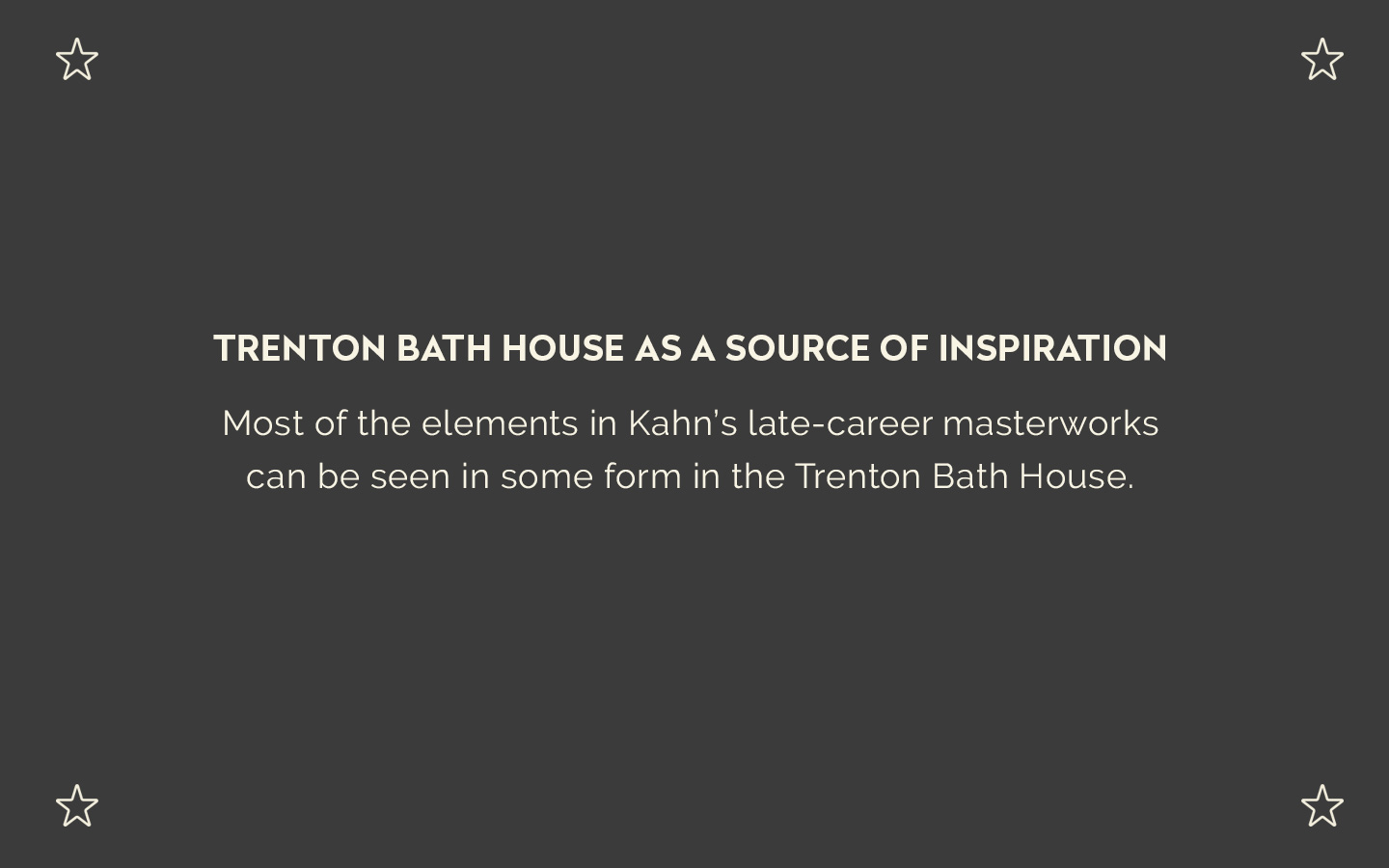
Kahn clarified his thinking about “servant” and “served” spaces designing the Alfred Newton Richards Medical Research Building at the University of Pennsylvania (1957–61). Hailed as an engineering marvel, the building was unsatisfactory to scientists because Kahn assumed that their research was carried on in studios the way architectural design is.
The entrances to the changing rooms in the Trenton Jewish Community Center, which were “servant” spaces, played the structural role of supporting the roof.
Photo courtesy of the Architectural Archives, University of Pennsylvania./ Courtesy of the Louis I. Kahn Collection, University of Pennsylvania and the Pennsylvania Historical and Museum Commission, photo by John Ebstel, 1956.

LIGHT
Kahn used a roof opening and light diffusers to mix natural and man-made light in the Kimbell Art Museum, Fort Worth, Texas (1966–72).
Kahn admitted natural light to the changing rooms in the Trenton Jewish Community Center through openings at the apex of the pyramidal roofs and via a gap of several feet between the roof line and the outside walls. His concern for the use of natural light carried over into all his later buildings.
Photo by Lucka Procka, © 2007, See http://goo.gl/XqfijF / Courtesy of the Louis I. Kahn Collection, University of Pennsylvania and the Pennsylvania Historical and Museum Commission, photo by John Ebstel, 1956.

GEOMETRY
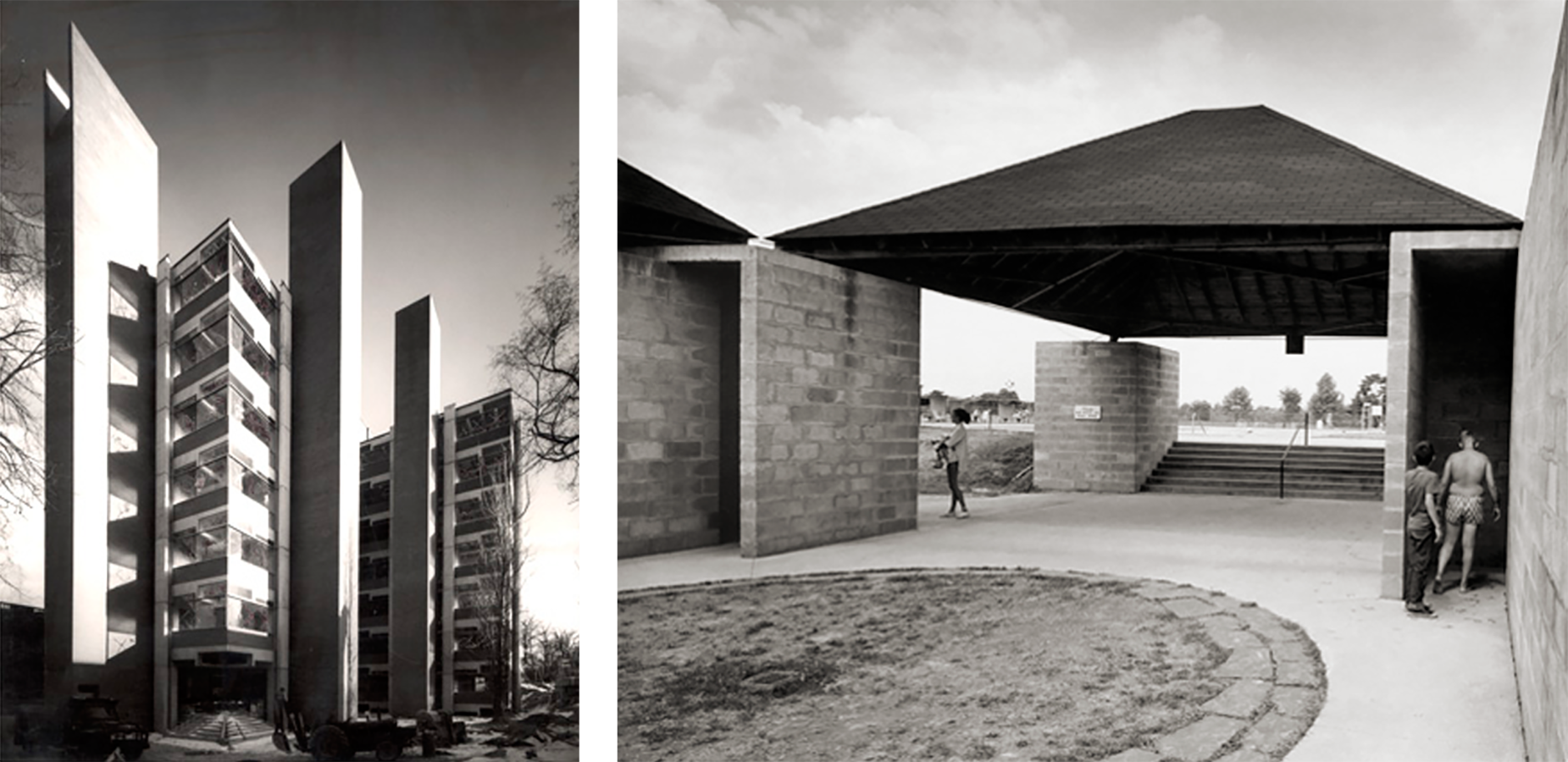
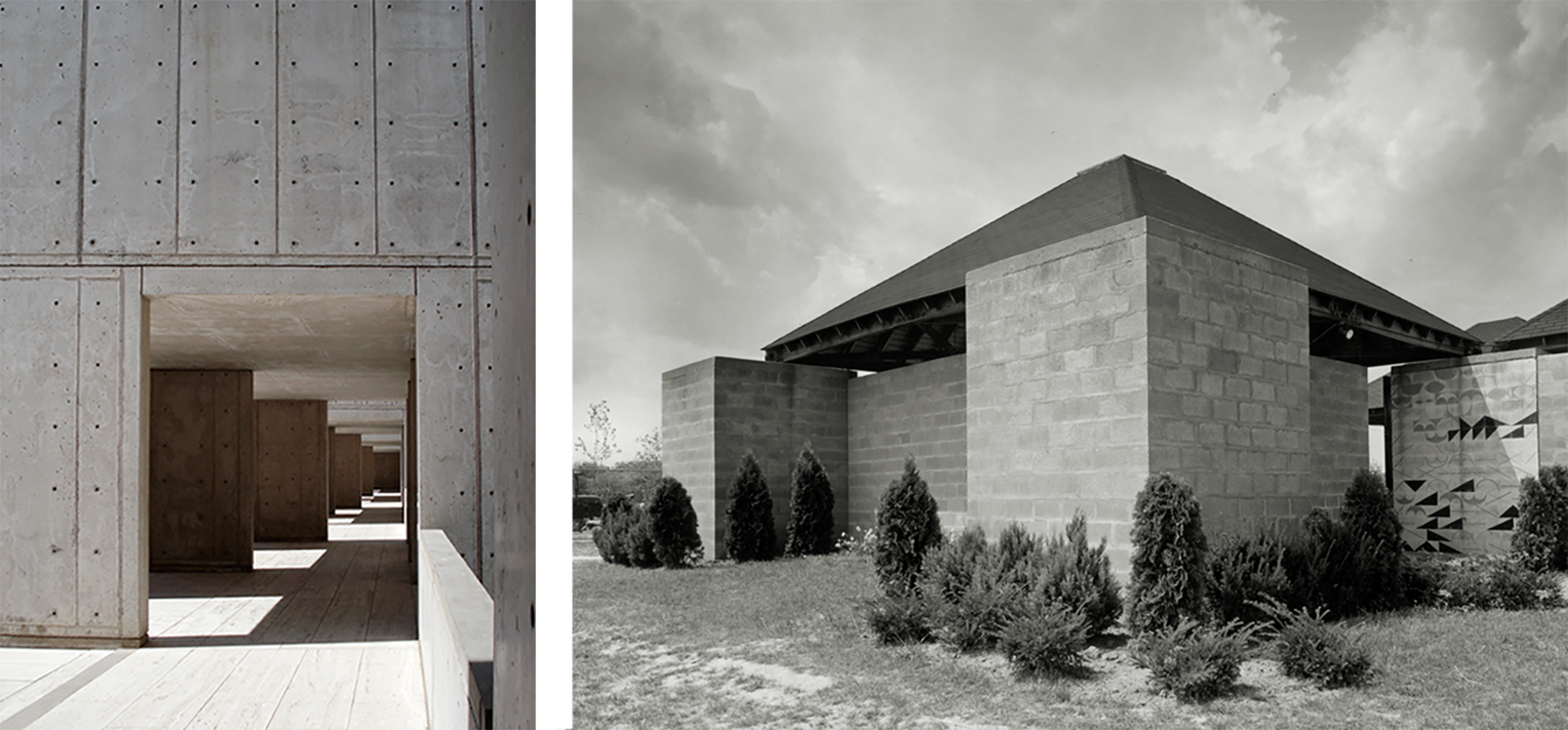
The Salk Institute for Biological Studies, La Jolla, California (1959–65), is said to be the first building Kahn was truly happy with; here he found the meaningful monumentality he had been looking for since Trenton.
The pristine geometry of the Bath House, shown in this 1957 picture of the mural and main entrance, found expression in numerous later Kahn works.
Photo courtesy of the Architectural Archives, The University of Pennsylvania. / Courtesy of the Louis I. Kahn Collection, University of Pennsylvania and the Pennsylvania Historical and Museum Commission, photo by John Ebstel, 1956.
MATERIALS
Kahn believed in an honest use of building materials, by which he meant two things: that the basic construction material should be simple and unadorned, and that a building’s surface should make visible how it was made. These principles are illustrated in the Salk Institute for Biological Studies, La Jolla, California (1959–65).
As shown in this view of the Trenton Jewish Community Center from the southeast, Kahn used unornamented cinder block, wood, and asphalt roof shingles for the Bath House.
Photo by Donna Lewis, Planning Director, Mercer County Planning Division, © 2008. / Courtesy of the Louis I. Kahn Collection, University of Pennsylvania and the Pennsylvania Historical and Museum Commission, photo by John Ebstel, 1956.
LANDSCAPE
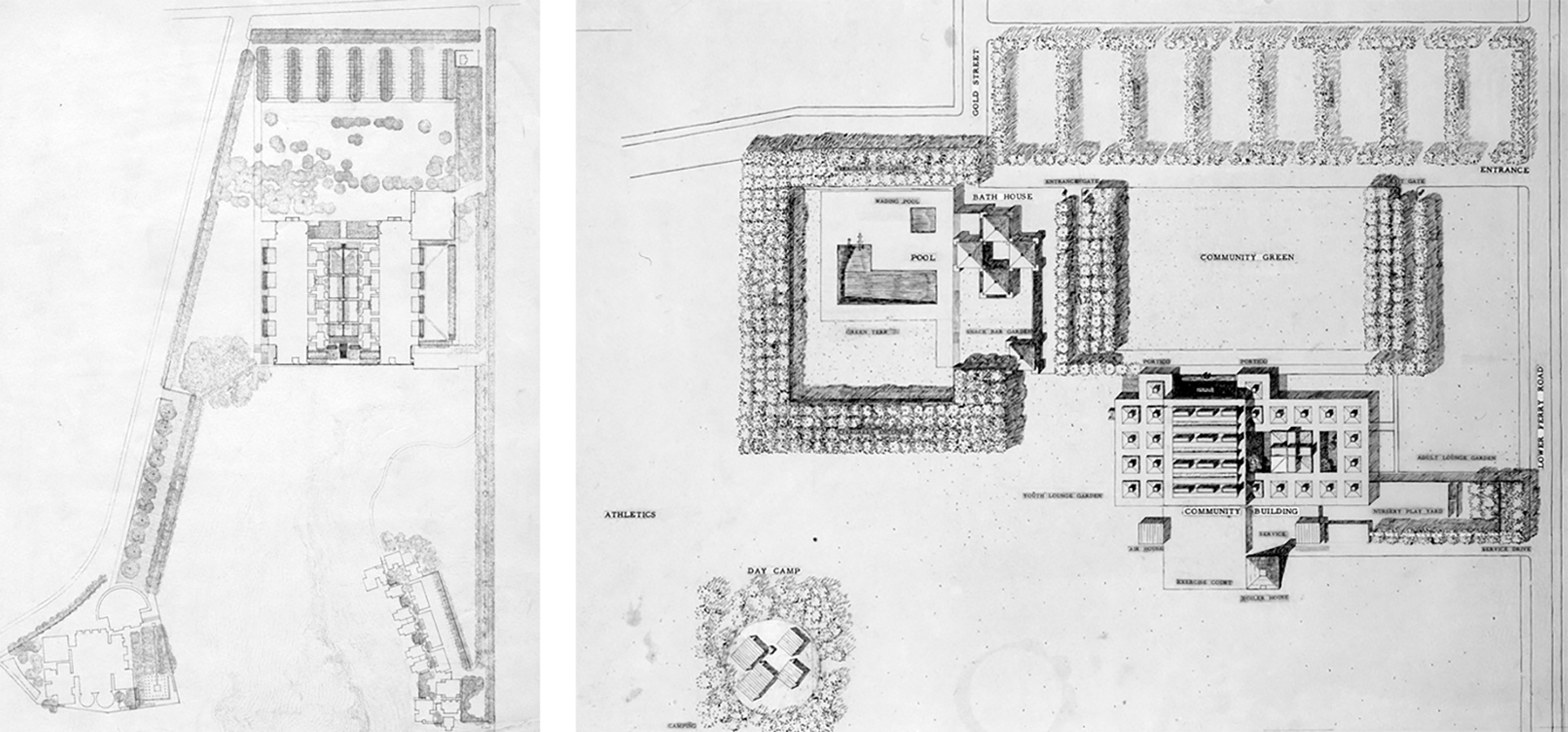
As shown by the schematic plan of the Trenton Jewish Community Center (right) and the site plan of the Salk Institute for Biological Studies (left), Kahn attempted to orchestrate outdoor spaces through the use of landscape materials. In both plans, he created a processional path from the parking lots to the building entrances.
Courtesy of the Architectural Archives, University of Pennsylvania. / Courtesy of the Louis I. Kahn Collection, University of Pennsylvania and the Pennsylvania Historical and Museum Commission, photo by John Ebstel, 1956.
explore